The high domes of ancient buildings have structural value (besides beauty). It arises from pressure difference on the two faces due to curvature (as in soap bubbles). There is a dome of radius 5 m and uniform (but small) thickness. The ‘surface tension’ of its masonry structure is about 500 N/m. Treated as hemispherical, the maximum load the dome can support is nearest to
Text Solution
Verified by ExpertsThe correct answer is:
B
Clearly the surface tension force on
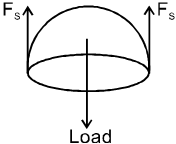
Hemisphere = F S = (2T). (2 π r) {2 layers are formed}.
⇒ F S = 2 × 500  × 2 × 3.14 × 5m.
≈ 30,000 N ≈ 3000 kg.wt.
Prepare Smarter with CGP Edu
Get practice questions, solutions, and test series in one place.
Write a Review
Share your experience with this question and solution.
Commentary
Send your comment, doubt, correction, or feedback to admin.
Similar Questions
Explore conceptually related problems
The temperature at which the surface tension of water is zero
Water rises to a height h in a capillary tube lowered vertically into water to a depth λ as shown i…
A soap bubble of radius r 1 is placed on another soap bubble of radius r 2 (r 1 < r 2 ). The radius…
At critical temperature, the surface tension of a liquid:
The excess pressure inside a soap bubble is equal to 2 mm of kerosene (density 0.8 g cm –3 ). If th…
Match the column
Column - IColumn - II(a) Spliting of brigger drop into small drops(P) Temperaturec…